Building a cool chatbot in a sandbox over a weekend is easy; turning that experiment into an enterprise-grade system that handles millions of requests safely, accurately, and cost-effectively is an entirely different discipline.
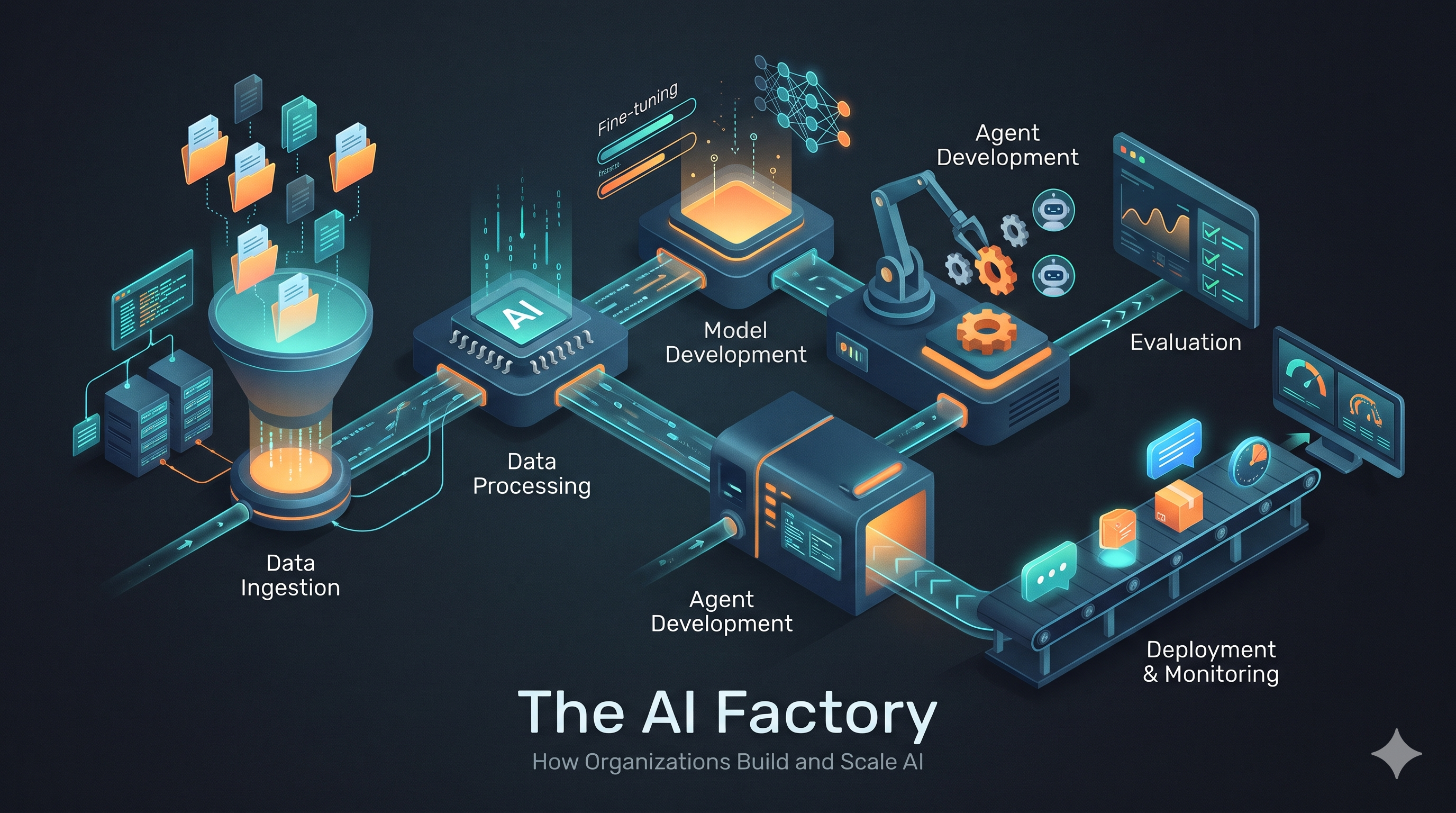
To bridge the gap between isolated experiments and real business value, forward-thinking organizations are adopting the AI Factory model. Rather than treating every new AI initiative as a custom, bespoke research project, an AI Factory establishes a unified, repeatable production pipeline that connects raw data, infrastructure, models, autonomous agents, evaluation frameworks, and deployment workflows under one roof.
A Real-World Lens: E-Commerce Customer Support
To see how an AI Factory operates in practice, imagine a fast-growing e-commerce retailer building an AI-powered customer support system. Their goal isn’t just a bot that recites FAQ pages—they want an intelligent system capable of checking live shipping statuses, processing returns, issuing refunds, and escalating frustrated shoppers to human specialists.
Here is how that retailer takes their support system from raw data to live customer interactions across the six core stages of the AI Factory—complete with a look at how the code is structured under the hood.
1. Data Ingestion: Unifying Fragmented Enterprise Sources
Every AI system is only as good as the context it can access. In the first stage, the factory establishes automated connectors to pull raw data from across the e-commerce ecosystem: historical support tickets, live order databases, warehouse inventory logs, and return policy documents. Instead of engineers manually scraping CSVs for a single project, reusable ingestion pipelines continuously stream records into a central repository.
# Stage 1: Standardized Data Ingestion Pipeline
from ai_factory.connectors import PostgresConnector, ZendeskStream

def ingest_support_context(batch_window: str = "1h"):
    # Pull live order records and recent customer tickets using shared factory connectors
    orders_db = PostgresConnector(dsn="vault://prod/orders_db")
    tickets_api = ZendeskStream(api_key="vault://prod/zendesk_key")

    raw_orders = orders_db.fetch_updated_records(window=batch_window)
    raw_tickets = tickets_api.pull_tickets(window=batch_window)

    return {"orders": raw_orders, "tickets": raw_tickets}
2. Data Processing: PII Scrubbing and Vector Indexing
Raw enterprise data is messy and full of sensitive customer details. During processing, automated workflows strip out personally identifiable information (PII) like credit card numbers and phone numbers to ensure compliance. Next, policy documents and ticket histories are chunked and converted into vector embeddings so the system can retrieve exact answers in milliseconds using Retrieval-Augmented Generation (RAG).
# Stage 2: Automated PII Redaction & Vector Embedding
import re
from ai_factory.embeddings import VectorStoreClient

def sanitize_and_index(documents: list[dict], vector_store: VectorStoreClient):
    cleaned_chunks = []
    for doc in documents:
        # Scrub credit card and phone patterns before any model sees the text
        safe_text = re.sub(r"\b(?:\d[ -]*?){13,16}\b", "[REDACTED_CARD]", doc["text"])
        safe_text = re.sub(r"\b\d{3}[-.]?\d{3}[-.]?\d{4}\b", "[REDACTED_PHONE]", safe_text)

        cleaned_chunks.append({"id": doc["id"], "content": safe_text, "metadata": doc["meta"]})

    # Upsert clean chunks into the central enterprise vector database
    vector_store.upsert_documents(collection="ecommerce_policies", docs=cleaned_chunks)
3. Model Development: Balancing Accuracy, Latency, and Cost
Rather than training a massive foundation model from scratch, the e-commerce team uses a centralized Model Gateway. They route simple ticket classification to a fast, low-cost model, while routing complex multi-step policy reasoning to a frontier model. Standardizing model registries here means any team in the company can swap or upgrade models via configuration without rewriting application code.
# Stage 3: Centralized Model Router
from ai_factory.models import ModelGateway

gateway = ModelGateway(config_path="factory_models.yaml")

def route_customer_query(query: str, complexity_score: float):
    # Route simple queries to fast/cheap models, complex disputes to reasoning models
    model_tier = "frontier-reasoning-v2" if complexity_score > 0.7 else "fast-tier-mini"

    return gateway.generate(
        model=model_tier,
        system_prompt="You are a verified e-commerce support specialist. Follow return policies strictly.",
        user_input=query,
        temperature=0.1
    )
4. Agent Development: Equipping Models with Secure API Tools
A model alone can only generate text; an agent can take action. In this stage, developers wrap the model with orchestration logic, memory, and secure tool access. When a customer asks, “Where is my order #4092, and can I swap the size?”, the support agent autonomously queries the shipping carrier API, checks warehouse stock, and initiates an exchange workflow—all within strict permission boundaries.
# Stage 4: Declaring Secure Agent Tools & Guardrails
from ai_factory.agents import Agent, tool

@tool(permissions=["orders:read", "refunds:write"])
def process_order_return(order_id: str, reason: str) -> dict:
    """Checks return eligibility within the 30-day window and issues a return label."""
    order = db.get_order(order_id)
    if order.days_since_delivery > 30:
        return {"status": "denied", "reason": "Outside 30-day return policy window."}

    label_url = shipping_api.create_return_label(order_id)
    return {"status": "approved", "return_label": label_url}

# Bind the approved tools and policy knowledge base to the customer support agent
support_agent = Agent(
    name="ecommerce_support_v1",
    model="frontier-reasoning-v2",
    tools=[process_order_return],
    knowledge_base="ecommerce_policies"
)
5. Evaluation: Automated Pre-Deployment Quality Gates
Before any AI agent talks to a paying customer, it must pass rigorous, automated testing. In an AI Factory, evaluation works just like unit testing in traditional software engineering. The factory runs the agent against thousands of simulated shopper scenarios—including angry customers and prompt-injection attempts—scoring the system on factual groundedness, tool-calling accuracy, and policy compliance.
# Stage 5: CI/CD Automated Evaluation Gate
from ai_factory.evals import EvalSuite, assert_groundedness, assert_tool_called

eval_suite = EvalSuite(dataset="golden_support_scenarios_v4.json")

def run_pre_deploy_checks(agent):
    results = eval_suite.run(
        target_agent=agent,
        metrics=[
            assert_groundedness(threshold=0.95), # Must not hallucinate return rules
            assert_tool_called(expected_tool="process_order_return")
        ]
    )
    if not results.passed:
        raise RuntimeError(f"Deployment blocked! Evaluation score {results.score} below threshold.")
6. Deployment and Monitoring: Continuous Observability in Production
Once the support agent passes evaluation, CI/CD pipelines deploy it into production behind feature flags and canary rollouts. Real-time observability wrappers track token costs, resolution latency, user feedback, and data drift. When the retailer launches a holiday flash sale with new return rules, any failed interactions are automatically flagged and fed right back into Stage 1 for continuous improvement.
# Stage 6: Production Telemetry & Guardrail Wrapper
from ai_factory.telemetry import monitor_execution

@monitor_execution(track_tokens=True, track_latency=True, alert_on_pii_leak=True)
def handle_live_chat(session_id: str, user_message: str):
    response = support_agent.run(session_id=session_id, input=user_message)

    # Automatically escalate to a human specialist if agent confidence drops
    if response.confidence < 0.65:
        return escalate_to_human_queue(session_id, transcript=response.history)

    return response.reply
Why the AI Factory Changes the Game
The true superpower of an AI Factory isn’t the first application you build—it’s how fast you build the second, third, and tenth.
Look closely at the code snippets above: notice how everything imports from a shared ai_factory internal library. Once the e-commerce company builds this foundation for customer support, they never have to start from scratch again. When the merchandising team asks for an AI shopping assistant, or the warehouse team needs an inventory forecasting agent, 80% of the engineering work is already done. Developers simply import the same PII-scrubbing pipelines, model routers, evaluation suites, and monitoring decorators.
By shifting from ad-hoc AI tinkering to an industrialized AI Factory, organizations slash time-to-market, keep infrastructure costs predictable, and turn AI from a scattered series of science projects into a compounding competitive advantage.